
Chile Tepin: The Tiny Wild Pepper Behind All the Heat
Chile tepin (chiltepin) is the wild ancestor of all domesticated peppers, packing 50,000-100,000 Scoville units into a pea-sized fruit. Learn about its ancient roots, conservation status, heat profile, and how to cook with this fiery Sonoran pepper.

Chile Tepin: The Tiny Wild Pepper Behind All the Heat
The pea-sized chiltepin is the wild ancestor of every jalapeño, bell pepper, and cayenne on Earth, packing 50,000 to 100,000 Scoville heat units into a fruit barely 8 millimeters across. That makes it roughly 14 times hotter than a jalapeño, yet its searing bite vanishes in seconds, a trait Sonorans call arrebatado (violent, rapid). For thousands of years, indigenous peoples of the Sonoran Desert have gathered this “mother of all peppers” from canyon floors shaded by mesquite and ironwood. Today, wild-harvested chile tepin fetches up to $80 a pound, making it one of the most expensive dried chiles in the world, while a new generation of James Beard-winning chefs is pushing it from rustic condiment to fine-dining star.
The Only Wild Chile Native to the United States

Chile tepin (Capsicum annuum var. glabriusculum) belongs to the Solanaceae (nightshade) family and holds a singular distinction in pepper botany: it is widely considered the direct wild progenitor of all domesticated C. annuum varieties. That lineage includes jalapeños, serranos, poblanos, cayennes, and bell peppers. Dr. Paul Bosland, Regents Professor Emeritus at New Mexico State University’s Chile Pepper Institute, puts it plainly: “The very first chile we have here is the Chiltepin, the wild chile. And that’s what I call ‘the mother of all chiles.’”
The name itself traces to Nahuatl, combining chilli (pepper) with tecpintl (flea), a nod to its diminutive size and sharp bite. Genetic and archaeological evidence places chile domestication approximately 7,000 years ago in central-east Mexico, with wild chiles utilized by humans for roughly 10,000 years (USDA Agricultural Research Service). University of Arizona ethnobotanist Gary Nabhan narrows the timeline further: “We think that chilies were domesticated in Puebla and Oaxaca about 5,800 years ago. That’s what linguistic evidence, archaeological evidence, and our co-author Kraig Kraft’s genetic studies demonstrate.”
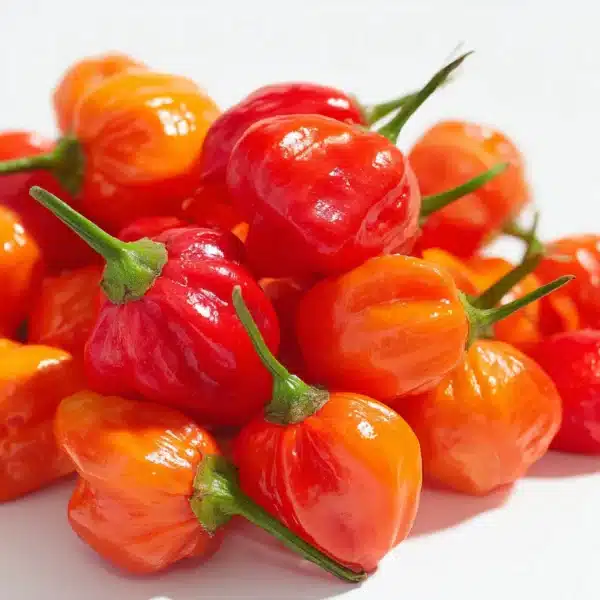
The plant itself is a perennial shrub (the species name annuum is actually a misnomer) that typically reaches one meter tall but can grow to three meters under ideal conditions. In frost-free areas, individual plants live 35 to 50 years. Its tiny white flowers with dark purple anthers give way to round, upward-pointing fruits that are green when immature and ripen to brilliant red or orange-red. The fruits measure roughly 8 mm (⅓ inch) in diameter, about the size of a peppercorn, and pop cleanly off the stem when ripe. This upright fruit orientation is an evolutionary strategy: birds, immune to capsaicin, eat the berries and scatter seeds across wide areas, while mammals, deterred by the burn, leave them alone. The Bird’s Eye chile, which shares the nickname “bird pepper,” uses a similar dispersal strategy but belongs to a different species (C. frutescens).
Chiltepin’s native range spans from southern Arizona and Texas through Mexico, Central America, and into northern Colombia. Its core habitat is the Sonoran Desert, where it grows in the dappled shade of “nurse trees” like mesquite, desert hackberry, and ironwood that protect it from scorching sun and frost. Fewer than 15 known wild populations exist in the United States, making it increasingly rare north of the border.
How 50,000 Scoville Units Feel and Fade
The standard Scoville rating for chiltepin is 50,000 to 100,000 SHU, though peer-reviewed studies have documented a wider range of 20,000 to 140,000 SHU depending on growing conditions. A 2013 study published in Molecules (González-Zamora et al.) found that chiltepin had the highest total capsaicinoid concentration among all C. annuum varieties tested, roughly twice the capsaicin and dihydrocapsaicin content of chile de árbol. Environmental stress amplifies this: drought conditions during flowering can increase capsaicin production by 23 to 40 percent (Journal of Agricultural and Food Chemistry, 2011), and green immature fruit at approximately 40 days after fruit set registers the hottest readings.
What makes chiltepin’s heat distinctive is not just its intensity but its temporal profile. Unlike a habanero’s slow-building, long-lingering burn, chiltepin delivers an immediate, front-palate explosion that peaks within 15 to 30 seconds and then dissipates almost entirely. This arrebatado quality makes it paradoxically versatile. You get the full drama of serious heat without the sustained suffering.
| Pepper | SHU Range | Times Hotter Than Jalapeño | Heat Category |
|---|---|---|---|
| Jalapeño | 2,500–8,000 | 1× (baseline) | Mild to Medium |
| Serrano | 10,000–23,000 | ~3× | Medium |
| Cayenne | 30,000–50,000 | ~8× | Hot |
| Chile Tepin | 50,000–100,000 | ~14× | Very Hot |
| Chile Pequin | 30,000–60,000 | ~9× | Hot |
| Habanero | 100,000–350,000 | ~43× | Very Hot |
| Carolina Reaper | 1,400,000–2,200,000 | ~312× | Super Hot |
The NMSU Chile Pepper Institute groups chiltepin alongside habaneros in the “very hot” tier, one step below the “super hot” category reserved for peppers exceeding one million SHU. Tasters describe a complex flavor profile beneath the heat: smoky, earthy, fruity, with subtle toasted-nut undertones and, as Nabhan writes, “the lingering taste of minerals, the thirsty desert earth itself.” Capsaicin, the compound responsible for chile heat, also carries potential anti-inflammatory and metabolic benefits. Research on capsaicin in peppers like turmeric’s curcumin and other bioactive spice compounds continues to grow, with a 2020 BMJ meta-analysis linking regular chile consumption to a 25% reduction in all-cause mortality risk.
From O’odham Pockets to Sonoran Dinner Tables
The cultural significance of chiltepin radiates outward from its Sonoran heartland. The Tohono O’odham people, the “Desert People” of southern Arizona, know it as a’al kokoli and have woven it into their foodways for millennia. A Tohono O’odham man told Gary Nabhan that “Tumacacori” means “place of the little round chilies” in the O’odham language, the very site where the Wild Chile Botanical Area now protects the largest wild chiltepin population north of Mexico. The pepper is so central to indigenous life in the region that, as the Food First Institute noted in 2025, “it is commonplace for the ingredient to permanently reside in the pockets of tribe members.”
The Tarahumara people of the Sierra Madre believed chiltepins were “the greatest protection against the evils of sorcery,” holding that any man who did not eat chile was “immediately suspected of being a sorcerer.” The Pima Bajo used them for stomach disorders; the Mayo made a leaf liniment; the Yaqui and Opata incorporated them into healing rituals. Thomas Jefferson, too, fell under the spell. He grew chiltepins in his garden after acquiring seeds from Captain Samuel Brown in San Antonio in 1812.
In Sonoran Mexican cuisine, chiltepin is less a specialty ingredient than a table essential. “A jar of chiltepines and chiltepinero, a mortar and pestle, often wooden and decorative, specifically meant for the chilies, are a staple of the Sonoran dinner table,” writes Alex La Pierre of the Border Community Alliance. “It’s almost a requisite… the region’s go-to spice.” Families crush dried chiltepins into soups, beans, eggs, and machaca (shredded dried beef). Green chiltepins are pickled en escabeche with wild oregano, garlic, and salt. Vinegar infusions, called vinagre de chiltepin, maintain their flavor for over 12 months. In Banámichi, Sonora, they even make chiltepin-flavored flan. For Southwestern carne asada, a sprinkle of crushed chiltepin over the finished meat adds a flash of heat that complements smoky char.
Wild Harvesting, Conservation, and “Sonora’s Red Gold”
Every September and October, multi-generational families trek into Sonoran canyons for the annual chiltepin harvest. Professional harvesters, known as chiltepineros, use a remarkable two-handed technique, picking rapidly with both hands and dropping fruit into aprons tied at the waist. Approximately 50 metric tons are commercially harvested in Mexico each year, primarily in Sonora, and for many rural households in the region, the harvest constitutes a significant portion of annual income. In 2011, chiltepines fetched $65 per kilogram at the source; by the time they reach U.S. retail, prices range from $70 to over $200 per pound depending on quality and sourcing.
This economic value creates conservation tension. A study cited by the Society of Ethnobiology found that chiltepines are overharvested in Sonora and Baja California, with commercial incentives encouraging complete stripping of plants. Climate change compounds the threat. Nabhan describes “a classic case of what Thomas Friedman calls ‘global weirding’” with prolonged droughts killing plants in northern Sonora while hurricanes like 2009’s Jimena devastated harvests further south. He estimates that more than half the chiltepines in northern Mexico and southern Arizona have been lost to weather extremes. Spadefoot Nursery, an Arizona native plant specialist, now recommends leaving wild plants alone entirely, warning they are “increasingly rare in Arizona… endangered by enthusiastic wild-harvesting, ranching, and development.”
Several protective measures exist. The Wild Chile Botanical Area, 2,500 acres in Rock Corral Canyon, Coronado National Forest, was established in 1999 as the first preserve for a wild botanical species in the United States. Wild chiltepins are also protected within Big Bend National Park and Organ Pipe Cactus National Monument. The Slow Food Foundation lists chiltepin on its international Ark of Taste, a catalog of endangered heritage foods. Native Seeds/SEARCH, the Tucson-based nonprofit Nabhan co-founded in the early 1980s, maintains a seed bank with over 1,900 accessions and recently uncovered 11 distinct chiltepin accessions that had been in long-term storage, running germination tests and distributing seeds to tribal communities through its Native American Seed Share program.
Chile Tepin vs. Chile Pequin: The Round One and the Pointed One
Perhaps no confusion in the pepper world is more persistent than the mix-up between chiltepin and chile pequin (also spelled piquin). In Texas, the names are used interchangeably. The Lady Bird Johnson Wildflower Center lists C. annuum var. glabriusculum under the common name “chile pequin,” and nurseries routinely mislabel one as the other. But they are distinct, and telling them apart is straightforward once you know what to look for.
Both are classified within Capsicum annuum var. glabriusculum, but pequin is considered a domesticated cultivar derived from the wild chiltepin. The single most reliable identifier is fruit shape: chiltepin produces round to slightly oval berries, while pequin fruits are distinctly elongated with a pointed tip, sometimes described as tic-tac shaped and measuring ¾ to 1 inch long versus the chiltepin’s ⅓-inch sphere. Chiltepin is the hotter pepper at 50,000 to 100,000 SHU versus pequin’s 30,000 to 60,000 SHU. Their heat profiles also differ markedly: chiltepin’s arrebatado flash contrasts with pequin’s slower onset and longer-lasting burn. On flavor, chiltepin leans smoky and earthy while pequin trends more citrusy and nutty. Traditional processing diverges as well. Chiltepins are always sun-dried, while pequins are commonly dried over wood smoke, giving them a distinctive smoky aroma that helps identify them in markets.
Other Mexican dried chiles like the ancho, guajillo, and Oaxaca chile each bring their own distinct flavor profiles to the table, but none share the chiltepin’s wild, foraged character or its flash-and-fade heat signature.
Growing Chile Tepin at Home Takes Patience but Pays Off
Home cultivation is absolutely possible, though chiltepin demands more patience than typical garden peppers. The primary challenge is germination. Wild seeds evolved to pass through bird digestive tracts, giving them a hard outer coat that resists sprouting under normal conditions. Several approaches improve success rates:
- Scarification: gently rub seeds on fine sandpaper or soak in dilute vinegar solution
- Heat mats: maintain consistent bottom heat of 80 to 90°F (27 to 32°C)
- Time: expect 7 to 21 days minimum, with some batches taking a month or longer
- Citric acid treatment: a 2024 study in MDPI Plants found that 0.45% citric acid for 48 hours effectively breaks dormancy
Native Seeds/SEARCH offers reassurance: “Scarification treatments are unnecessary if adequate warmth and time are provided.” Once established, the plants are remarkably low-maintenance and drought-tolerant. In USDA Zones 9b through 11, chiltepin grows as an evergreen perennial. Roots survive temperatures down to 15°F (-9°C), with tops dying back and resprouting in spring. In cooler zones, container growing works well; use a minimum 5-gallon pot and bring it indoors for winter.
The critical cultural detail: in hot desert climates, chiltepin needs partial shade, mimicking its wild habit of growing beneath nurse trees. Full sun works only in cooler regions. Plant in well-drained, slightly alkaline soil, water deeply but infrequently, and expect fruit in 80 to 150 days after transplanting. The reward is a plant that, in the right conditions, will produce fiery little berries for decades. If you’re also growing herbs alongside your peppers, our guide on how to make your own dried herbs covers the basics of harvesting and drying at home.
Chefs and Markets Are Driving a Chiltepin Renaissance
A new wave of Southwestern chefs is moving chiltepin from abuela’s kitchen to national recognition. René Andrade, the 2024 James Beard Award winner for Best Chef: Southwest, grew up foraging chiltepin in Nogales, Sonora, and features it prominently at his Phoenix restaurant Bacanora, calling it “the red gold of Sonora, a tiny chile with generations of history.” Lawrence “LT” Smith, named one of Food & Wine’s Best New Chefs in 2024, literally named his Phoenix restaurant Chilte after the pepper. His mole Negro combines super-dark cocoa with chiltepin, and Bon Appétit named Chilte one of the best new restaurants in America. Matt Carter of The Mission in Scottsdale develops barrel-aged fermented chiltepin hot sauce in-house, while James Beard Award winner Janos Wilder has championed indigenous Sonoran ingredients including chiltepin in Tucson since 1983.
Artisanal producers are scaling the opportunity. Brands like La Perrona, Chiltepin El Rey, and La Sonorita offer small-batch chiltepin hot sauces, while creative applications include chiltepin-infused honey, cocktail rimming blends, cold-brew coffee (Tucson’s Exo Roast Co.), and chocolate truffles. The broader market context is favorable: the global chili pepper market is valued at approximately $11.56 billion in 2026 and growing at 6.6% annually (Fortune Business Insights, 2025), with “growing demand for exotic and premium chili varieties” identified as a defining trend. The pepper seeds market, valued at $657 million in 2023 (Grand View Research), is being driven in part by increasing demand for heirloom and non-GMO varieties, exactly the category where chiltepin sits. U.S. per capita chile consumption reached 7.7 pounds per person in 2017 (USDA Economic Research Service), up 8% in just two years, and foodservice chains report that spicy menu builds now exceed 78% penetration (Technomic, 2024).
How to Cook with Chile Tepin
For home cooks approaching chiltepin for the first time, the universal advice is simple: start small. One or two crushed dried chiltepins will transform a pot of beans or a bowl of soup. A tablespoon of dried chiltepins is sufficient for a full batch of salsa from six Roma tomatoes. Toast whole dried peppers for 30 seconds on a dry skillet before crushing to enhance their smoky character, and add them at the end of cooking to preserve volatile flavor compounds.
Chiltepin pairs beautifully with Mexican spice rubs for grilled meats, especially when combined with cumin, oregano, and garlic. Try crushing a few into your next DIY seasoning blend alongside smoked paprika and brown sugar for a Sonoran-style BBQ rub. The pepper also works surprisingly well in desserts: chiltepin-spiked chocolate truffles and hot cocoa are gaining popularity in the Southwest, much like the baking spices traditionally used in sweets.
Proper storage matters with dried chiltepins. Keep them in an opaque, airtight container away from light and heat. Properly stored, they retain their potency for 12 to 18 months. Whole dried chiltepins last longer than crushed, so buy them whole and grind as needed.
Spice Station carries whole dried chile tepin sourced for maximum heat and flavor. For anyone building a dried chile collection, our Chile Set includes tepin alongside ghost pepper, pequin, cayenne, and five other varieties. Browse our full chiles collection to find the right pepper for your kitchen.
Frequently Asked Questions
What is chile tepin?
Chile tepin (chiltepin) is a tiny, round wild pepper classified as Capsicum annuum var. glabriusculum. It is the only chile pepper native to the United States and is considered the wild ancestor of all domesticated C. annuum varieties, including jalapeños, serranos, and bell peppers. It rates 50,000 to 100,000 on the Scoville scale.
How hot is a chile tepin compared to a jalapeño?
Chile tepin is roughly 14 times hotter than a jalapeño, rating 50,000 to 100,000 SHU compared to the jalapeño’s 2,500 to 8,000 SHU. The key difference is that chiltepin’s heat hits immediately and fades within 30 seconds, while many other peppers produce a slower, longer-lasting burn.
What is the difference between tepin and pequin peppers?
The most obvious difference is shape: tepin peppers are round (about ⅓ inch across) while pequin peppers are elongated with pointed tips (¾ to 1 inch long). Tepin is also hotter (50,000 to 100,000 SHU vs. 30,000 to 60,000 SHU) and delivers a flash-and-fade heat, while pequin has a slower, more sustained burn with citrusy flavor notes.
Can you grow chile tepin at home?
Yes. The main challenge is germination, which requires consistent warmth of 80 to 90°F and patience (up to a month). Once established, chiltepin is drought-tolerant and long-lived, surviving 35 to 50 years in frost-free climates. In hot regions, provide partial shade. In cooler zones (below USDA 9b), grow in containers and overwinter indoors.
Why is chile tepin so expensive?
Wild-harvested chiltepin ranges from $70 to over $200 per pound because the peppers are still gathered by hand from wild plants in remote Sonoran canyons. The tiny fruit size means harvesters collect small volumes per trip, and wild populations are shrinking due to climate change and overharvesting, further limiting supply.
What does chile tepin taste like?
Beyond the heat, chiltepin offers smoky, earthy, and fruity flavors with subtle toasted-nut undertones. Ethnobotanist Gary Nabhan describes the experience as “the lingering taste of minerals, the thirsty desert earth itself.” The complex flavor profile sets it apart from one-note hot peppers and explains its status as a table condiment across Sonoran Mexico.
Is chile tepin endangered?
Chiltepin is not federally listed as endangered, but it is considered at risk. Fewer than 15 wild populations exist in the United States, and overharvesting combined with climate change has reduced populations across its range. The Slow Food Foundation lists it on its Ark of Taste, and the Wild Chile Botanical Area in Arizona was created specifically to protect wild chiltepin.
How do you use dried chile tepin in cooking?
Start with one or two crushed dried chiltepins per serving. Toast whole peppers for 30 seconds on a dry skillet before crushing to bring out their smoky flavor. Add them to soups, beans, eggs, salsas, and grilled meats. Chiltepin is traditionally crushed tableside with a chiltepinero (small mortar and pestle) and sprinkled over finished dishes.


